
ByJohn A
What Makes Artificial Intelligence Different From Traditional Software?
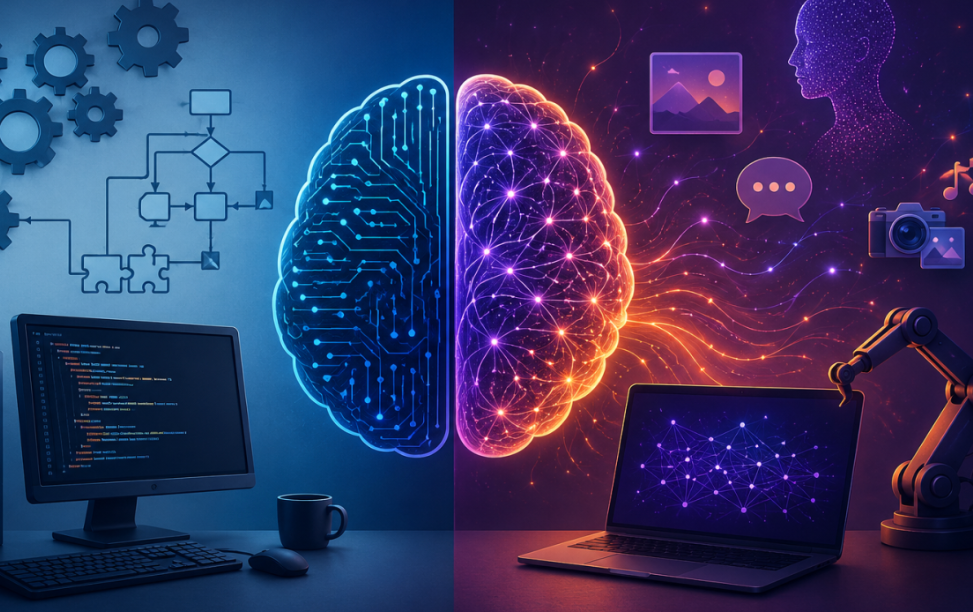
Artificial intelligence learns from data and experience, unlike traditional software that follows fixed rules. It adapts to new inputs and situations, often producing probabilistic rather than deterministic outputs. Representations shape what AI can know and how it reasons, which requires governance, transparency, and guardrails. Uncertainty is inherent, and explanations may be probabilistic or partial. This blend of learning, generalization, and autonomy raises questions about accountability and how to manage risk as systems evolve. The stakes point to careful, ongoing scrutiny.
What AI Learns That Traditional Software Doesn’t
Artificial intelligence learns from data and experience in ways traditional software does not. The field emphasizes data representation as foundational, shaping what the system can know and how it interprets patterns.
Model reasoning then synthesizes these representations into decisions, revealing adaptability beyond fixed rules. This transparency supports responsible deployment and freedom to question assumptions, while guarding against unexamined biases.
See also: Why Artificial Intelligence Is Becoming Essential for Businesses
How AI Handles Uncertainty and Ambiguity Differently
Uncertainty and ambiguity pose distinct challenges for AI, demanding approaches that quantify confidence and communicate limitations alongside results. The design emphasizes uncertainty management, presenting probabilistic outputs and rationale to users while clarifying what remains unknown.
Ambiguity resolution relies on context-aware constraints, conservative defaults, and transparent failure modes, ensuring responsible guidance in free-choice environments and honoring user autonomy without overclaiming precision.
How Learning, Generalization, and Adaptation Shape AI
Learning, generalization, and adaptation determine how AI systems extend beyond their initial programming. These processes enable models to extrapolate patterns, revise expectations, and respond to unfamiliar inputs with informed restraint.
Yet learning generalization and adaptation uncertainty require transparent safeguards, reflecting normative concerns about reliability, accountability, and human autonomy in deployment. Cautious design preserves freedom while mitigating unintended consequences across domains.
From Rules to Autonomy: Implications for Software Development
From rules to autonomy marks a shift in software development from prescriptive instruction to emergent capability, prompting a reevaluation of design, governance, and risk. The transition introduces autonomy tradeoffs, requiring careful evaluation of reliability, accountability, and control. Organizations must articulate governance considerations that balance freedom with safety, ensuring transparent decision processes, verifiable outcomes, and responsible stewardship amid evolving autonomous software systems.
Frequently Asked Questions
How Does AI Scale Beyond Human-Intuitive Reasoning?
AI scaling extends beyond Human reasoning by leveraging data abundance and parallel computation; however, it demands transparent safeguards, normative oversight, and careful risk assessment, so an audience seeking freedom can responsibly harness AI scaling without overreliance on intuition.
Can AI Explain Its Decisions Transparently?
Ironically, yes, but with caveats: AI can show traces of its decision process, yet true transparent reasoning remains imperfect. The model interpretability is partial, urging caution, normative standards, and respect for audience freedom while explaining outcomes.
What Are Ai’s Limits in Creative Problem Solving?
AI’s limits in creative problem solving include reliance on training data, struggle with truly novel contexts, and sensitivity to creative constraints; data bias can skew outputs, demanding transparent evaluation, precautionary governance, and normative, freedom-focused perspectives.
How Is AI Governance and Ethics Enforced in Practice?
“68% of organizations report evolving governance maturity within two years.” AI governance and ethics enforcement are implemented through formal policies, independent audits, and transparent reporting; safeguards, accountability, and continual risk assessment guide responsible deployment in freedom-oriented, precautionary norms.
Will AI Replace Human Developers or Augment Them?
AI collaboration will augment rather than replace human developers, enabling developer augmentation while preserving agency; it democratizes creativity, yet requires guardrails. The view is precautionary, transparent, normative, stressing freedom to choose and responsibly shape technology.
Conclusion
Artificial intelligence reshapes software by learning from data, not merely executing hand-coded rules. AI handles uncertainty through probabilistic reasoning, offering transparent rationale and guardrails. Learning, generalization, and adaptation enable responsiveness to novel inputs, but also demand new governance and accountability. A cautionary anecdote: a weather app predicting rain from noisy signals once misled users into outdoor plans; the system’s probabilistic output highlighted risk, not certainty, underscoring the need for clear explanations and robust oversight in autonomous software.